Digital Twin in Manufacturing: Implementation Guide With Proven ROI
Last updated: April 10, 2026
9 min read
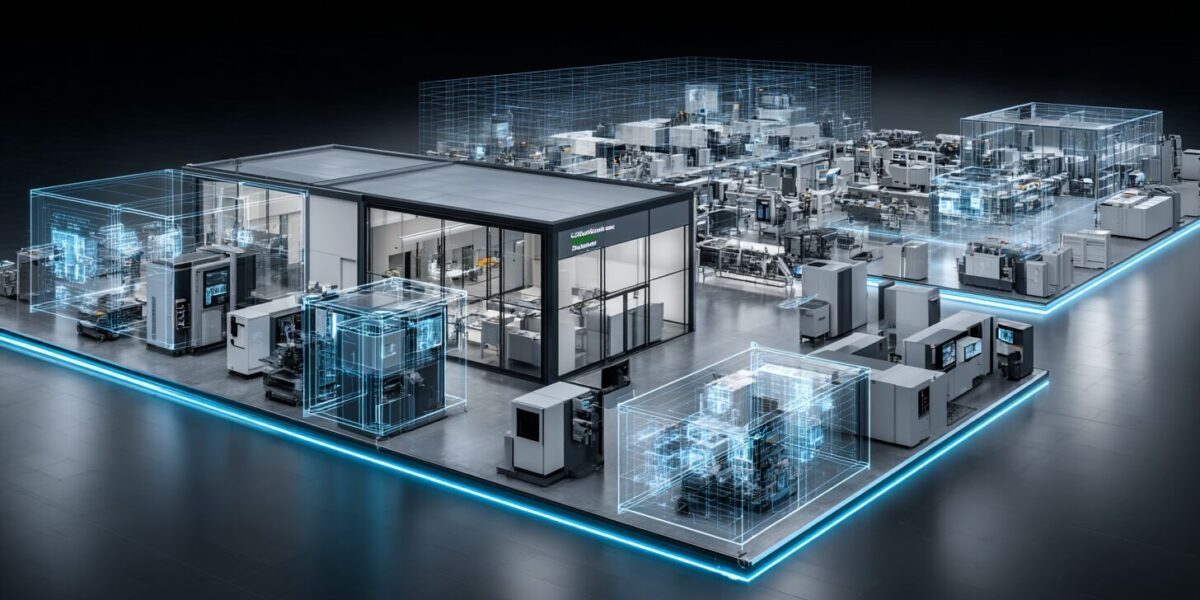
Digital twin technology is reshaping how manufacturers design, monitor, and optimize their operations. A digital twin is a virtual replica of a physical asset, process, or entire production line that receives real-time data from IoT sensors and simulates performance under varying conditions. According to McKinsey, manufacturers that deploy digital twins across their operations see a 20–30% improvement in key performance metrics within the first 18 months. For operations managers weighing the digital twin cost against potential gains, the math increasingly favors adoption: Gartner reports that 75% of organizations implementing IoT already use or plan to use digital twins by 2027. This guide walks you through the architecture, implementation phases, ROI calculation framework, and real-world case studies that prove digital twin software delivers measurable returns on the factory floor.
What Is a Digital Twin and Why Manufacturing Needs One
A digital twin creates a bidirectional data bridge between your physical operations and a virtual model that mirrors them in real time. Unlike static CAD models or one-time simulations, digital twins continuously ingest sensor data—temperature, vibration, throughput, energy consumption—and update their virtual state accordingly. According to NIST, a properly implemented digital twin must include three core elements: the physical entity, the virtual counterpart, and the data connection linking them.
The value proposition for manufacturers is concrete. Digital twin software enables predictive maintenance that reduces unplanned downtime by 45%, according to Deloitte’s 2025 manufacturing survey. Production line simulations let engineers test process changes virtually before committing capital. Quality control becomes proactive rather than reactive: anomalies flagged in the digital twin often precede physical defects by hours or days.
- Predictive maintenance: Vibration and thermal data predict bearing failures 14 days in advance
- Process optimization: Simulate throughput changes without stopping the line
- Quality assurance: Detect drift in process parameters before defects reach output
- Energy management: Model energy consumption patterns and identify 12–18% savings opportunities
Digital Twin Architecture: Components You Need
Building a digital twin requires four interconnected layers that work together as a unified system. The physical layer consists of IoT sensors, PLCs, and edge gateways that collect operational data at intervals ranging from milliseconds to minutes depending on the process criticality. According to Gartner, the average manufacturing digital twin ingests data from 150–300 sensor points per production line.
The data layer handles ingestion, storage, and preprocessing. Time-series databases like InfluxDB or TimescaleDB store sensor readings, while message brokers such as Apache Kafka or MQTT manage real-time data streaming. According to McKinsey, data infrastructure typically represents 35% of total digital twin implementation cost, making it the single largest budget line item.
- Physical layer: IoT sensors, PLCs, edge computing gateways (budget: 5,000–0,000 per line)
- Data layer: Time-series DB, message broker, ETL pipelines
- Model layer: Physics-based simulation, machine learning models, 3D visualization
- Application layer: Dashboards, alert systems, optimization recommendations
The model layer is where digital twin software differentiates itself. Leading platforms like Siemens Xcelerator, PTC ThingWorx, and Azure Digital Twins combine physics-based simulation with machine learning to create models that improve their accuracy over time. The application layer surfaces insights through dashboards, automated alerts, and optimization recommendations that operators can act on immediately.
Implementation Phases: A 4-Stage Roadmap
Get articles like this in your inbox every week.
Successful digital twin implementation follows a phased approach that builds capability incrementally while delivering ROI at each stage. According to Deloitte, manufacturers that attempt full-scale deployment without phased rollout experience 3x higher failure rates and 60% budget overruns compared to those following a staged approach.
Phase 1 — Asset Monitoring (Months 1–3): Connect sensors to a single critical asset, establish data pipelines, and build a basic visualization dashboard. Target: real-time visibility into one machine’s performance. Typical digital twin cost for this phase: 5,000–5,000 including sensors, software licenses, and integration labor.
Phase 2 — Predictive Analytics (Months 4–8): Layer machine learning models onto the data stream to predict failures and quality issues. According to NIST, achieving reliable predictive accuracy requires a minimum of 90 days of historical data across normal and abnormal operating conditions. Target: 30% reduction in unplanned downtime for the monitored asset.
Phase 3 — Process Optimization (Months 9–14): Expand the digital twin to cover an entire production line. Build simulation capabilities that let engineers test parameter changes virtually. Target: 10–15% throughput improvement through optimized settings.
Phase 4 — Enterprise Scale (Months 15–24): Roll out across multiple lines and facilities. Integrate with ERP, MES, and supply chain systems. Target: plant-wide visibility and cross-facility benchmarking.
Calculating Digital Twin ROI: A Practical Framework
Digital twin ROI calculation requires quantifying both hard savings and productivity gains against total cost of ownership. According to McKinsey, the median manufacturing digital twin delivers 8–12x ROI over a 5-year period, with payback typically occurring in months 14–22.
Start with your baseline costs in four categories: unplanned downtime (average cost per hour × annual hours lost), scrap and rework (defect rate × production volume × unit cost), energy waste (consumption above theoretical minimum), and maintenance spending (reactive vs. planned ratio). These form your improvement targets.
ROI Formula:
Annual ROI = [(Downtime Savings + Quality Savings + Energy Savings + Maintenance Savings) − Annual Digital Twin Cost] / Annual Digital Twin Cost × 100
- Downtime savings: 35–50% reduction in unplanned stops × your hourly downtime cost (,000–0,000/hr typical)
- Quality savings: 20–30% scrap reduction × annual scrap cost
- Energy savings: 12–18% reduction × annual energy spend
- Maintenance savings: 25–40% reduction in emergency repair costs
According to Gartner, total cost of ownership for a single-line digital twin runs 50,000–00,000 in the first year (including hardware, software, and integration), dropping to 0,000–0,000 annually for ongoing operation. For a plant running 3 shifts with 0,000/hr downtime cost and 200 hours of annual unplanned downtime, even a conservative 35% downtime reduction saves .4 million annually—a clear case for digital twin pricing at current market rates.
Real-World Case Studies: Digital Twins Delivering Results
Siemens deployed digital twins across its Amberg Electronics Plant, creating virtual replicas of 1,200 production stations. According to McKinsey’s analysis of the facility, the implementation achieved a 99.99885% quality rate—roughly 11 defects per million units—while reducing time-to-market for new products by 50%. The digital twin cost was recovered within 11 months through quality improvements alone.
Unilever implemented digital twin software across 8 factories to optimize energy consumption and production scheduling. According to Deloitte, the deployment reduced energy costs by 16% (8 million annually) and cut carbon emissions by 22,000 metric tons per year. The company used Azure Digital Twins integrated with existing SCADA systems, keeping implementation costs to .2 million across all sites.
A mid-size automotive parts manufacturer (350 employees, 20M revenue) deployed a single-line digital twin for its CNC machining center. Within 6 months, predictive maintenance reduced unplanned downtime from 180 hours to 62 hours annually. According to NIST documentation of the project, the 80,000 investment generated 90,000 in first-year savings—a 218% ROI.
Choosing the Right Digital Twin Software
The digital twin software market offers platforms ranging from enterprise suites costing 00,000+ annually to modular solutions starting at 0,000. According to Gartner’s 2025 Magic Quadrant for Manufacturing Digital Twin Platforms, the top-tier vendors are Siemens (Xcelerator), PTC (ThingWorx), and Microsoft (Azure Digital Twins), each excelling in different use cases.
Siemens Xcelerator dominates in discrete manufacturing environments where CAD integration and physics-based simulation are critical. PTC ThingWorx leads in IoT-heavy deployments with its superior edge connectivity and augmented reality capabilities. Azure Digital Twins offers the most flexible cloud-native architecture, making it ideal for organizations already invested in the Microsoft ecosystem. According to Deloitte, 62% of successful implementations use a hybrid approach combining a commercial platform with custom analytics modules.
- Enterprise (500+ employees): Siemens Xcelerator or PTC ThingWorx — full-featured, proven at scale
- Mid-market (100–500 employees): Azure Digital Twins or AWS IoT TwinMaker — modular, pay-as-you-grow
- SMB (<100 employees): Open-source frameworks (Eclipse Ditto) + custom dashboards — lowest digital twin cost
Common Pitfalls and How to Avoid Them
According to McKinsey, 65% of digital twin pilot projects fail to scale beyond the initial proof of concept. The primary failure modes are predictable and preventable: insufficient data quality, lack of cross-functional buy-in, and over-engineering the initial scope.
Data quality is the foundation. Sensors producing unreliable readings make the digital twin worse than useless—it becomes a source of false confidence. According to NIST, manufacturers should invest 15–20% of their digital twin budget in sensor calibration, data validation pipelines, and anomaly detection before building models. Start with 20–30 high-quality sensor points rather than 300 noisy ones.
- Pitfall: Building the perfect model before proving value — Fix: Start with monitoring, add intelligence incrementally
- Pitfall: IT-only project without shop floor input — Fix: Include operators from Phase 1; their domain knowledge is irreplaceable
- Pitfall: Ignoring change management — Fix: Train operators on dashboards, show them how data improves their daily work
- Pitfall: No clear success metrics — Fix: Define KPIs before deployment; measure baseline for 60 days minimum
What does a digital twin cost for a mid-size manufacturer?
A single production line digital twin typically costs 50,000–00,000 in the first year, including IoT sensors (5,000–0,000), digital twin software licenses (0,000–50,000), integration and customization (0,000–20,000), and training (0,000–0,000). Annual operating costs drop to 0,000–0,000 after the initial build. According to Gartner, the median payback period for manufacturing digital twins is 14–22 months.
How long does digital twin implementation take?
A phased implementation takes 18–24 months from initial sensor deployment to enterprise-scale operation. According to Deloitte, the first monitoring-only phase can be operational in 8–12 weeks, delivering immediate visibility value. Predictive capabilities require 4–8 months of data accumulation before models reach production-grade accuracy.
Can small manufacturers benefit from digital twin technology?
According to NIST’s Manufacturing Extension Partnership data, manufacturers with as few as 25 employees have achieved positive ROI from targeted digital twin deployments. The key is focusing on a single high-value asset—such as a CNC machine or injection mold—rather than attempting plant-wide coverage. Open-source digital twin frameworks like Eclipse Ditto reduce software costs to near zero, making the sensor hardware the primary expense at 5,000–0,000.
What IoT sensors are needed for a manufacturing digital twin?
The essential sensor types depend on your application but typically include vibration sensors (accelerometers), temperature sensors (thermocouples or RTDs), current/power monitors, flow meters, and pressure transducers. According to McKinsey, 80% of actionable digital twin insights come from just 3–4 sensor types. Start with vibration and temperature sensors on rotating equipment—they catch 70% of common failure modes at a fraction of the cost of full instrumentation.
How does a digital twin integrate with existing MES and ERP systems?
Modern digital twin software provides API-based integration with major MES platforms (Siemens Opcenter, Rockwell Plex, MPDV) and ERP systems (SAP, Oracle, Microsoft Dynamics). According to Gartner, OPC-UA is the dominant protocol for shop floor data exchange, while REST APIs handle business system integration. Most implementations use a middleware layer or integration platform (MuleSoft, Dell Boomi) to orchestrate data flow between systems without modifying existing configurations.
You May Also Like




⚙ Related Articles
 Industry Guides
Manufacturing Employee Retention Strategies: 9 Tactics That Actually Work in 2026
Manufacturing employee retention strategies that work in 2026: onboarding, wage ladders, supervisor quality, scheduling, and recognition — with data.
 Industry Guides
Workforce Training Implementation Checklist: A Comprehensive Guide for Manufacturers
Learn how to create a workforce training implementation checklist that boosts OEE and reduces defects. Start now!
 Industry Guides
Workforce Training vs Traditional Methods: A Comprehensive Comparison for Manufacturers
Discover how workforce training vs traditional methods impacts OEE and defect rates. Download our free ROI calculator today!