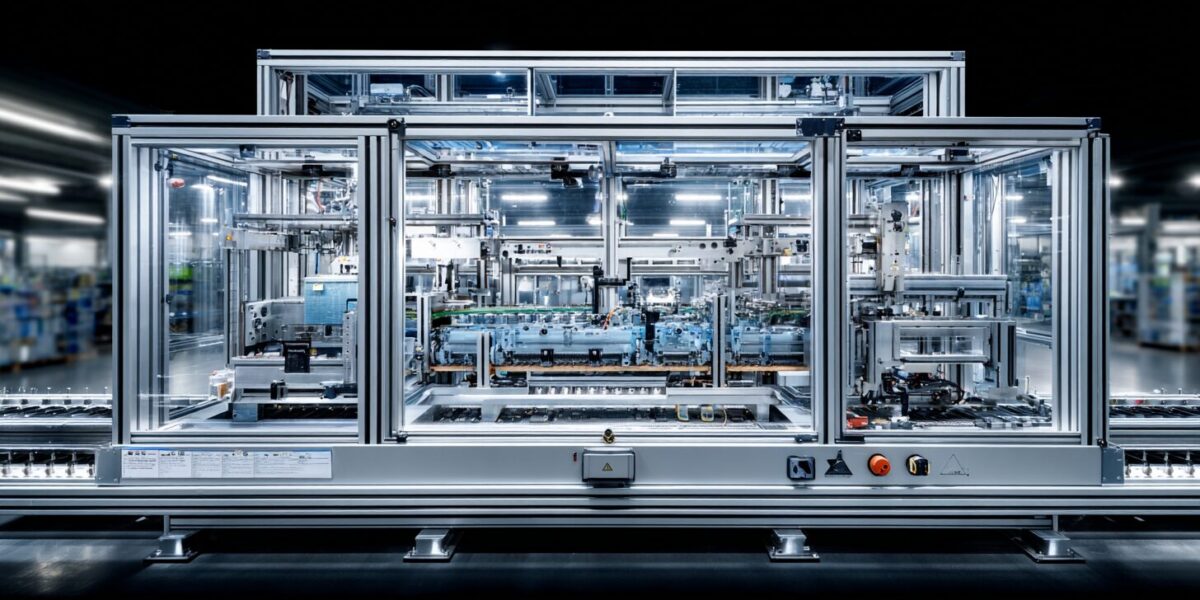
Poka Yoke Examples in Manufacturing: 12 Mistake-Proofing Applications That Work
Last updated: April 16, 2026
10 min read
Poka yoke — Japanese for “mistake-proofing” — prevents human error from ever reaching the customer. Coined by Shigeo Shingo as part of the Toyota Production System, poka yoke sits alongside jidoka and just-in-time as a pillar of lean manufacturing. According to the Lean Enterprise Institute, plants that systematically deploy poka yoke devices reduce defect escape rates by 60% to 90% within the first 12 months of adoption.
This article walks through 12 proven poka yoke examples used across automotive, electronics, food, and aerospace manufacturing today. Each example pairs the problem it solves with the device type, investment level, and measurable outcome so you can match a solution to your own line. The common thread: every example costs far less to install than the defects it prevents.
1. Limit Switch Fixtures That Stop the Machine Unless the Part Is Seated Correctly
A limit switch poka yoke is the workhorse of mistake-proofing. A spring-loaded fixture holds a contact closed only when the part orientation is correct. If the operator loads the part upside down or backwards, the circuit stays open and the cycle-start button does nothing.
A major U.S. automotive tier-one supplier installed limit switch fixtures on 40 CNC stations for roughly $280 per station and eliminated a $1.2 million annual scrap problem within six months. According to the Society of Manufacturing Engineers, limit switch poka yoke devices have the shortest payback period of any mistake-proofing technique — typically under 90 days.
Design guidelines:
- Always use redundant switches (two sensors wired in series) for safety-critical parts
- Mount switches so chips and coolant cannot reach the contact
- Wire the output to both the PLC and a visual andon light so operators see the failure reason
2. Color-Coded and Shape-Coded Connectors
Electrical assembly is a defect goldmine without poka yoke. A technician wiring a vehicle harness faces 60 to 200 connectors per unit, and a single swapped pair can cause a warranty claim costing hundreds of dollars. The solution: connectors that physically cannot mate with the wrong counterpart.
Automotive OEMs now specify unique keyways, colors, and locking tabs for every connector pair on a harness. According to SAE International standards, connector poka yoke reduces harness assembly defects by 95% compared to identical connectors distinguished only by labels. The cost difference at scale is roughly $0.08 per connector — trivial against the warranty tail it eliminates.
Electronics contract manufacturers use the same principle on board-to-board connectors. A recent iSixSigma case study documented a $3.4 million annual savings at a medical device plant after standardizing on keyed USB and ribbon connectors across 12 product families.
3. Vision System Torque Confirmation
Get articles like this in your inbox every week.
Bolt-tightening errors account for roughly 14% of automotive warranty claims, according to the American Society for Quality. Modern poka yoke combines a smart torque wrench with a vision system that tracks which bolt the operator is engaging. The station refuses to advance until all bolts show green on the overhead display.
Implementation costs $8,000 to $25,000 per station depending on the camera and wrench brand. Ford, Toyota, and Stellantis plants report that vision-confirmed torque stations reduce bolt-related warranty claims by 85% and also accelerate training — new operators reach certification in 40% less time because the system flags errors in real time rather than after the fact.
For plants without capital for full machine-vision stations, a simpler variant uses a socket tray with proximity sensors that detects which socket was picked up last. If the operator reaches for the wrong size, the tool beeps and the torque cycle is blocked.
4. Count-Verification Tote Systems for Kitting
Kitting errors ripple downstream for weeks. A missing fastener discovered at final assembly triggers a line stop, a root-cause investigation, and often a rework loop that costs 10 to 20 times the original kitting step. Count-verification poka yoke puts a load cell or light curtain over the kitting area that tracks exactly how many parts leave the bin.
According to research from the Kaizen Institute, weight-based kitting verification reduces kitting errors from the typical 0.8% to under 0.05% — a 94% reduction. Light-curtain systems that count hand entries into a bin achieve similar results and cost $1,500 to $4,000 per bin to install.
The most robust implementations combine both: weight for heavy metal parts, light curtains for small fasteners and seals. An aerospace supplier documented $900,000 in avoided rework in the first year after installing this hybrid system across 28 kitting stations.
5. Go/No-Go Gauges at the Machinist’s Station
Not every poka yoke needs electricity. A go/no-go gauge is a precision-machined block with two openings: one sized at the upper tolerance, one at the lower. If a finished part slides through the “go” side but not the “no-go” side, it is within spec. The operator checks every piece in under two seconds.
According to ASQ, go/no-go gauges remain the most cost-effective defect catch for dimensional errors in CNC machining. A single precision gauge runs $150 to $600 and lasts for decades with periodic calibration. Plants implementing go/no-go checks at every machining cell typically see dimensional escape rates drop from 3,000 DPMO to under 200 DPMO within 90 days.
The discipline matters more than the tool itself: gauges must be chained to the machine so they cannot walk off, calibration stickers must be current, and the standard work must require a gauge check after every setup change.
6. Andon Light Escalation for Missing Steps
An andon system is poka yoke for process sequence. At each station, the operator must press a “step complete” button or scan a barcode as proof that the work was done. If the next station’s sensor detects the part arriving without the previous station’s timestamp, a yellow andon light flashes and the line slows to a controlled stop.
According to the Toyota Production System Support Center, andon-enabled stations detect 80% of missed-step errors before the part leaves the assembly cell. Modern wireless andon kits deploy in 3 to 5 days at $500 to $1,500 per station and integrate directly with existing MES platforms like Rockwell FactoryTalk or Siemens Opcenter.
A best-practice refinement: log every andon pull with timestamp, operator, and reason code. The resulting Pareto chart guides continuous improvement, because the top three error codes usually account for 70% of all pulls — fix those three and the plant’s first-pass yield jumps measurably.
7. Torque-Angle Monitoring on DC Tools
Fastener engineers know that torque alone does not guarantee clamp load. A bolt tightened to the correct torque can still be undertightened if the threads are dry, or overtightened if the fastener was reused. Torque-angle monitoring combines both signals: the tool measures torque as it climbs and the rotation angle past yield.
According to SAE J1701 and the Fastener Industry Institute, torque-angle strategy reduces clamp-load variation by 40% to 70% compared to torque-only tightening. The cost premium over a standard DC tool is roughly 30%, or about $2,800 to $4,500 per tool, but the warranty reduction on safety-critical joints like seat brackets, engine mounts, and steering columns makes the payback under 12 months.
Modern tools also log every fastening event with operator ID, torque curve, and angle, creating a permanent audit trail that satisfies IATF 16949 traceability requirements.
8. Weight-Check Stations for Filled Containers
Food, pharmaceutical, and chemical manufacturers cannot rely on operator judgment for fill accuracy. A weight-check poka yoke uses a checkweigher conveyor that scales each container as it passes and automatically diverts any unit outside tolerance to a reject lane.
According to the U.S. FDA’s Current Good Manufacturing Practice guidelines, checkweighers are the accepted method for net-weight compliance on packaged goods. Modern high-speed checkweighers handle 600 units per minute at accuracies of ±0.05 grams and cost $25,000 to $80,000 depending on throughput. Plants report ROI within 8 months on product categories where underfill lawsuits or overfill giveaway exceed 1% of revenue.
Pair the checkweigher with a feedback loop to the filler: the filler’s PLC adjusts fill volume in real time based on checkweigher data, keeping giveaway below 0.3% without risking underfill.
9. Barcode-Triggered Pick-to-Light Racks
At a parts rack with 40 bins, the probability of reaching into the wrong bin climbs with fatigue. A pick-to-light poka yoke scans the work order barcode and then illuminates only the correct bin. A confirmation button at each bin must be pressed before the next bin lights up.
According to research from the Warehousing Education and Research Council, pick-to-light systems reduce picking errors from the typical 1% to under 0.1% — a 10x improvement — and also increase pick rate by 30% to 50% over paper kitting sheets. Deployment costs $150 to $400 per bin plus a control system at $8,000 to $20,000.
Plants running high-mix low-volume production cite pick-to-light as their single highest-ROI poka yoke because the cost scales linearly with bins while the error savings scale with SKU count.
10. Jigs and Templates That Physically Block Wrong Orientation
A mechanical jig is the cheapest and most reliable poka yoke ever invented. If the part can only be loaded one way because the fixture has asymmetric locating pins, no training and no discipline is needed — the geometry enforces the correct outcome.
Shingo called this “prevention-level” poka yoke and argued it should always be the first option considered. A welding fixture with three locating pins in an L-pattern, for example, makes it physically impossible to weld a left-hand bracket where a right-hand belongs. Cost: typically $400 to $2,000 for a machined fixture, versus tens of thousands for electronic detection.
The Lean Enterprise Institute estimates that 60% of manual-assembly defects could be eliminated with mechanical jigs alone, yet only 15% of plants systematically use them. The missing ingredient is design-for-assembly engagement with the product engineering team — once engineers see how cheap a locating pin is compared to a vision system, fixture requests accelerate.
11. RFID Tool and Fixture Authentication
In high-mix plants, operators change tools and fixtures 20 to 50 times per shift. Using the wrong tool on the wrong job is a common error mode. RFID poka yoke tags every fixture and reader at every workstation; if the operator mounts the wrong fixture, the machine refuses to cycle.
Automotive stamping plants pioneered this technique for die changes on 800-ton presses, where a mismatched die can cause $50,000 in tooling damage plus a week of downtime. RFID die authentication systems cost $15,000 to $40,000 per press and typically pay back on the first averted mismatch.
The same technology scales down to hand tools. A torque wrench with an RFID reader will unlock only when held over the correctly-numbered socket, ensuring torque values and bolt identities always match.
12. Simulation-Based Setup Verification (Digital Poka Yoke)
The newest generation of poka yoke is software-based. A digital twin of the production line runs the upcoming work order virtually before the real machine starts. The simulation flags missing tools, incompatible materials, or PLC programs not yet updated.
According to McKinsey research, plants using simulation-based setup verification reduce first-piece defects on changeovers by 65% and cut average changeover time by 30%. Implementation requires a tightly integrated MES-CAM-PLC stack and typically costs $75,000 to $300,000 for the software plus integration work.
This approach shines in aerospace and low-volume high-value manufacturing where a single defective first-piece can destroy a $40,000 forging. The ROI case is weaker in high-volume automotive, where the first-piece cost is low enough that physical gauges suffice.
Frequently Asked Questions
What is the best poka yoke example for a new lean program?
Start with go/no-go gauges on your three highest-volume dimensional features and color-coded connectors on your most error-prone electrical harness. Both approaches cost under $2,000 to deploy and show measurable results within 30 days. According to the Shingo Institute, early wins with simple mechanical poka yoke are the strongest predictor of long-term program success because they build operator trust in the methodology.
How much does a typical poka yoke device cost?
Mechanical poka yoke (jigs, gauges, fixtures) costs $150 to $2,000 per device. Electromechanical devices (limit switches, andon systems) run $500 to $5,000 per station. Vision-based systems cost $8,000 to $25,000 per station, and enterprise-grade digital poka yoke with simulation costs $75,000 and up. The rule of thumb: prevention-level poka yoke costs one-tenth of detection-level poka yoke, which is why Shingo advocated designing prevention in whenever possible.
Why is poka yoke important in manufacturing?
Poka yoke breaks the link between human attention and product quality. Even the most skilled operator will make roughly one mistake per 1,000 repetitive operations when tired or distracted, according to human-factors research published in the International Journal of Industrial Ergonomics. Poka yoke drives that error rate toward zero, which makes quality a function of system design rather than operator vigilance. The business result is predictable yield, lower warranty cost, and safer work.
What are the types of poka yoke?
Shingo defined three types: contact (physical shape, limit switch, jig), fixed-value (counts a specific number of actions before allowing the next step), and motion-step (sequences must occur in a defined order). A second classification distinguishes prevention-level (the error cannot occur) from detection-level (the error is caught immediately after it occurs). Prevention-level is always preferred when feasible.
How do I choose the right poka yoke for my plant?
Follow four questions: What is the defect mode? What is the cost of the defect escaping? What is the simplest mechanism that eliminates or detects the error? What is the total cost of ownership including training and maintenance? Build a Pareto chart of your top 10 defect modes, then assign a poka yoke concept to each. According to the Kaizen Institute, plants tackling their top 5 defect modes with targeted poka yoke typically eliminate 70% of their total defect cost within 12 months.
You May Also Like




⚙ Related Articles
 Industry Guides
Supply Chain Optimization for Small Manufacturers: 7 Actionable Strategies That Save 30%+ on Costs
Stop losing 30% of working capital to inventory. Learn cash flow-focused supply chain optimization tactics for small manufacturers. Get the free framework...
 Industry Guides
Factory Floor Layout Planning Best Practices: 5 Actionable Strategies for Optimal Production Flow
Discover 5 factory floor layout planning best practices that slash waste, boost output & improve safety. Get actionable steps to optimize your...
 Industry Guides
Factory Employee Training Program: Build a High-Performance Workforce with Proven Tactics
Stop losing new hires with generic training. Build a factory-specific employee training program that maps to real tasks, cuts turnover by 37%,...